Introduction
The document examines the framework governing data retention and erasure under the Digital Personal Data Protection Act, 2023 (DPDP Act). Its primary objective is to explain how the Act regulates the duration for which organizations may retain personal data and the circumstances requiring its deletion. The discussion focuses on statutory obligations, rights of Data Principals, interaction with other laws, the DPDP Rules, 2025, judicial developments, and constitutional challenges. The Act replaces indefinite data storage with a purpose-based retention regime while preserving statutory exceptions.
Background
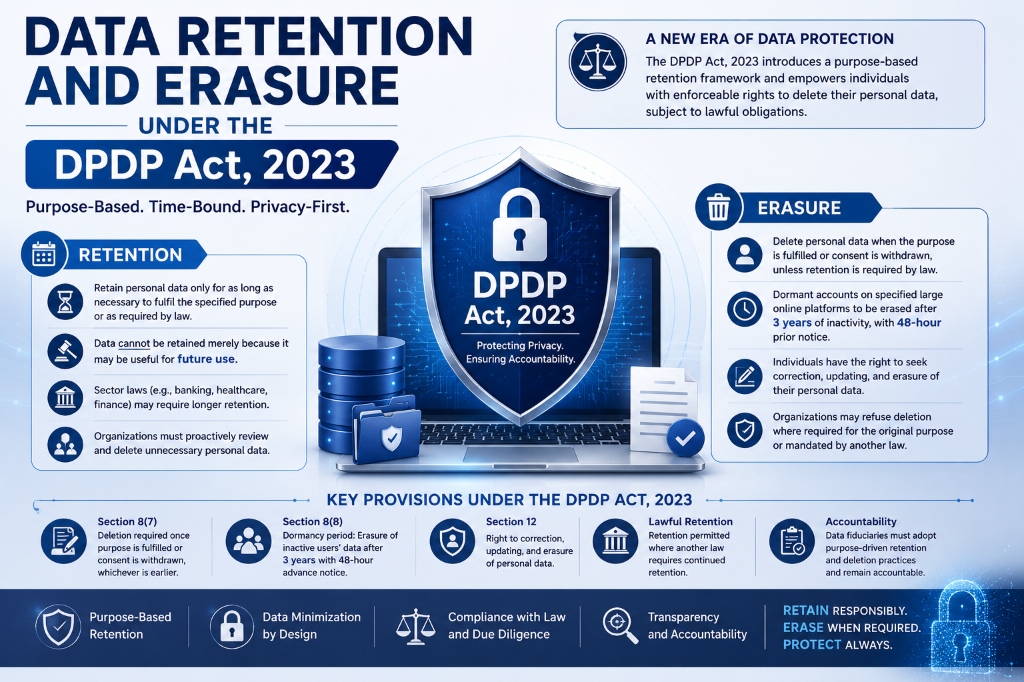
The DPDP Act establishes that personal data must be deleted once the purpose for which it was collected has been fulfilled unless another law expressly requires longer retention. It also grants individuals the right to seek deletion of their personal data. Data cannot be retained merely because it may prove useful in the future.
Key Legal Issues and Main Themes
- Section 8(7) requires deletion of personal data once consent is withdrawn or the specified purpose ceases, whichever occurs first, unless another law requires retention.
- Organizations must proactively review and delete unnecessary personal data without waiting for requests. The Act illustrates this by contrasting online marketplace transactions with bank account closures, where banking regulations require longer retention.
- Section 8(8) introduces the concept of a dormancy period. Under the DPDP Rules, 2025, specified large online platforms must erase inactive users’ personal data after three years of inactivity, subject to a mandatory 48-hour advance notice.
- Section 12 grants Data Principals the right to request correction, updating, and erasure of personal data. This right primarily applies to consent-based processing. Organizations may refuse to be erased where retention remains necessary for the original purpose or is required by another law. The Rules also prescribe response timelines and require reasons to be communicated when requests are refused.
Important Statutory Provisions
The summary discusses Sections 8(7), 8(8), 12, 12(3), 17(1)(c), and 44(3) of the DPDP Act together with Rules 8 and 14 of the Digital Personal Data Protection Rules, 2025.
Important Judicial Decisions
The document examines the pending Supreme Court challenge concerning Sections 44(3) and 17(1)(c), including reference to CPIO, Supreme Court of India v. Subhash Chandra Agarwal (2019). It also discusses Jorawer Singh Mundy v. Union of India, Dharamraj Bhanushankar Dave v. State of Gujarat, Karthick Theodre v. Registrar General, Madras High Court, and Justice K.S. Puttaswamy v. Union of India (2017).
Core Arguments
The DPDP Act shifts Indian data protection law from indefinite retention to purpose-limited retention. Organizations must justify continued retention through statutory authority while individuals enjoy enforceable erasure rights subject to legal exceptions.
Major Findings and Analysis
The Act co-exists with sector-specific laws governing banking and healthcare records. Rather than overriding them, Sections 8(7) and 12(3) preserve statutory retention obligations wherever another law requires continued retention. The framework will continue to evolve through subordinate legislation, the Data Protection Board, and judicial interpretation.
How JTS Lex Can Assist?
Strategic DPDP Compliance Advisory by JTS Lex
Navigating the statutory obligations of the DPDP Act, 2023, alongside overlapping sector-specific retention requirements (such as RBI, PMLA, or tax mandates), presents significant operational and legal complexities for organizations, if needed. JTS Lex provides tailored legal counsel to help Data Fiduciaries structure robust compliance frameworks. The firm assists clients by conducting comprehensive data mapping audits, drafting purpose-driven retention policies, and formulating clear protocols for managing Data Principal erasure requests under Section 12. Furthermore, JTS Lex, if required, advises entities on mitigating liabilities associated with data dormancy under Section 8(8), managing Data Processor contracts, and aligning legacy databases with statutory deletion mandates to ensure seamless operational adherence and risk reduction before the Data Protection Board.
Schedule Consultation with Team JTS LexConclusion
The DPDP Act represents a significant shift in Indian data protection law by requiring organizations to retain personal data only for as long as necessary to fulfil the specified purpose. Organizations should establish purpose-based retention and deletion practices proactively to ensure compliance as enforcement develops.
Navigating DPDP Act Compliance in Healthcare: A Practical Guide for Hospitals and Healthcare Providers →
A practical compliance guide for hospitals and healthcare providers navigating Data Fiduciary responsibilities, patient consent architecture, and statutory safeguards under the DPDP framework. Read Article