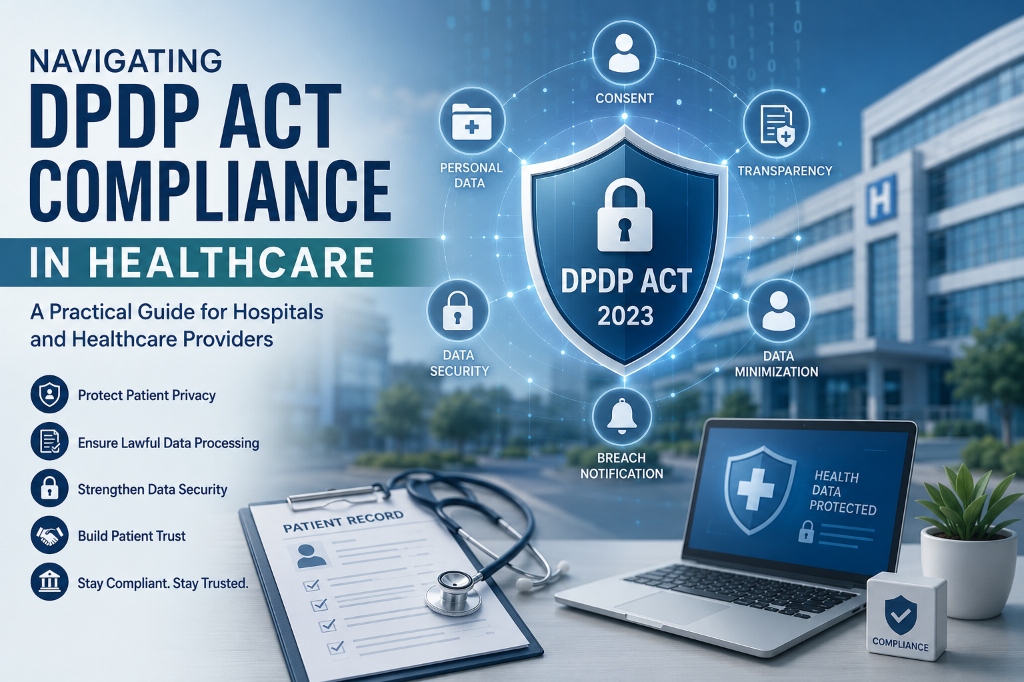
Executive Summary:
Healthcare providers operate at the delicate intersection of medical care and high-volume sensitive data management. Every patient interaction—from routine registration to complex surgical procedures—generates a digital footprint containing confidential personal, financial, and diagnostic data.
With the enactment of the Digital Personal Data Protection Act, 2023 (DPDP Act) and the Digital Personal Data Protection Rules, 2025, data protection is no longer merely an IT protocol—it is a core pillar of clinical governance, legal risk management, and institutional trust. Non-compliance exposes healthcare institutions to severe financial penalties, regulatory litigation, and lasting reputational damage.
The Operational Reality: Why Hospitals are Primary Data Fiduciaries:
A modern hospital continuously processes digital personal data across its entire operational ecosystem, including:
- Outpatient (OPD) and Inpatient (IPD) Registration
- Electronic Health Records (EHR) and Medical Records (EMR)
- Diagnostic Laboratories and Imaging Systems
- Pharmacy Management Software
- Insurance Claims and Third-Party Administrator (TPA) Processing
- Telemedicine Platforms and Mobile Health Applications
- CCTV Surveillance in Clinical and Administrative Areas
- HR and Employee Records
Because each of these touchpoints involves collecting, storing, or transferring digital personal data, every healthcare provider qualifies as a Data Fiduciary under the DPDP framework.
Key Provisions of the DPDP Framework Applicable to Healthcare:
Technical Security: Implement end-to-end database encryption, strict role-based access control (RBAC), multi-factor authentication (MFA), and routine vulnerability testing.
Vendor Management: Hospitals remain strictly accountable for third-party processors, including cloud platforms, diagnostic vendors, billing agencies, and TPAs. Contractual frameworks must explicitly enforce compliance standards.
Strategic Compliance Checklist for Healthcare Leaders:
To establish institutional compliance, healthcare organizations should take immediate steps:
-
Conduct a Data Mapping Audit: Track the end-to-end lifecycle of patient data across all hospital departments.
-
Standardize Privacy Notices: Update online portals, paper forms, and reception signage with DPDP-compliant notices.
-
Refine Consent Mechanisms: Implement verifiable consent capture and logging systems within your HMIS/EMR software.
-
Harden Cybersecurity Protocols: Enforce strict access controls, encryption, backup redundancy, and regular security audits.
-
Update Third-Party Contracts: Re-evaluate vendor and TPA agreements to include binding data protection obligations.
-
Train Clinical and Administrative Staff: Conduct ongoing training on patient data privacy, secure record handling, and breach awareness.
-
Establish a Grievance Mechanism: Designate a Data Protection Officer (DPO) or Grievance Officer and publish clear reporting channels.
Consequences of non-compliance:
Failing to comply with the DPDP framework exposes healthcare providers to severe risks:
- Statutory Fines: Financial penalties reaching up to ₹250 Crore per violation.
- Regulatory Proceedings: Formal inquiries and enforcement actions by the Data Protection Board of India.
- Institutional Risk: Permanent loss of patient trust, class-action litigation, and severe reputational damage.
- Operational Disruption: Business interruption following ransomware incidents or administrative sanctions.
The Road Ahead:
With compliance deadlines under the Digital Personal Data Protection framework set to take full effect by May 13, 2027, healthcare institutions must act proactively. Transitioning a complex medical enterprise into full compliance requires time, structural integration, and legal precision.
Early preparation ensures seamless compliance without compromising clinical workflows or patient care standards.
How JTS Lex Assists Healthcare Providers, if needed?
At JTS Lex, we provide comprehensive legal, regulatory, and corporate advisory services to help hospitals and healthcare networks navigate the evolving digital privacy landscape, if needed.
Our specialized healthcare compliance services include:
- End-to-end Data Protection Audits & Gap Assessments.
- Drafting Customized Privacy Notices, Consent Forms, and Patient Agreements.
- Reviewing and Restructuring Vendor, TPA, and Cloud Provider Contracts.
- Formulating Data Breach Response Plans & Grievance Redressal Mechanisms.
- Legal Advisory on Regulatory Obligations before the Data Protection Board of India.
- Executive & Staff Training on Healthcare Data Privacy.
Why Every Business Needs a Data Protection Lawyer →
DPDP Act compliance is now a boardroom issue. Learn why every business needs a data protection lawyer to manage risk, consent & vendor liability. Read Article