"The Ultimate Shock Absorber": How CCIL Prevents Financial Systemic Collapse
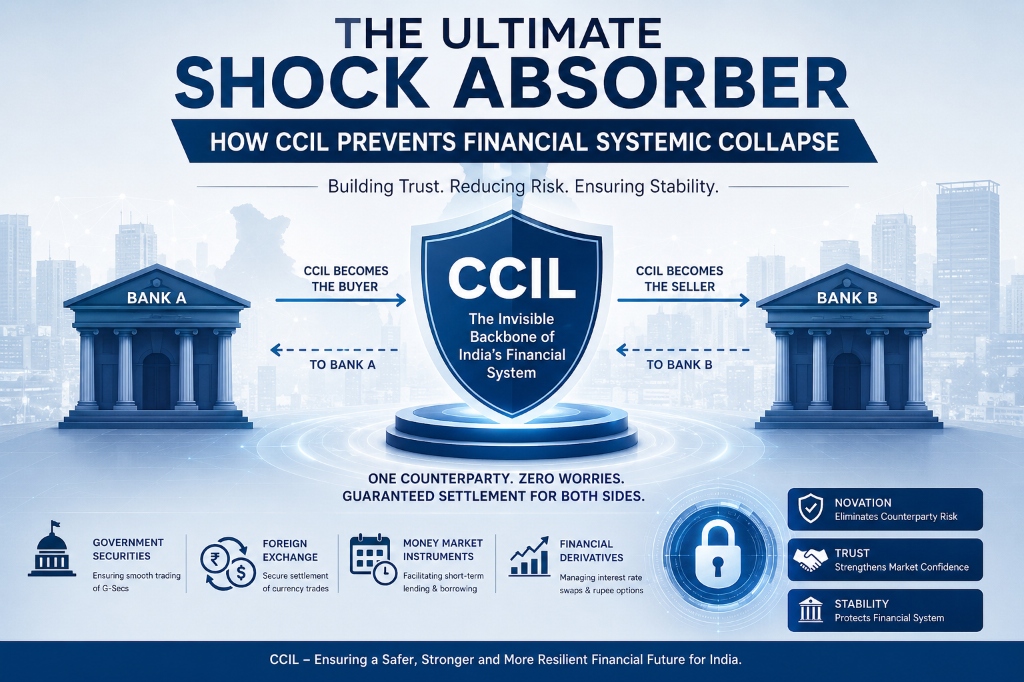
Quick Answer: The Clearing Corporation of India Limited (CCIL) is India's premier Central Counterparty (CCP), established in April 2001 under Reserve Bank of India (RBI) guidance. Regulated under the Payment and Settlement Systems Act, 2007, CCIL acts as the legal clearing house for Government Securities (G-Secs), Forex, Money Market, and Derivative transactions. CCIL prevents systemic financial collapse using the legal doctrine of Novation: stepping between trading counterparties to become the buyer to every seller and seller to every buyer. If a bank defaults overnight, CCIL absorbs the settlement obligation, eliminating domino financial contagion.
1. What is CCIL & Its Role in Financial Markets
The Clearing Corporation of India Limited (CCIL) operates as the "invisible backbone" of India's sovereign financial infrastructure.
Established in April 2001 under Reserve Bank of India guidance, CCIL clears transactions worth trillions of rupees daily across money, bond, and forex markets.
Prior to CCIL, bilateral transactions exposed trading banks directly to counterparty default risk, creating severe financial systemic vulnerability.
CCIL eliminates bilateral risk by acting as a Central Counterparty (CCP), guaranteeing settlement even if a counterparty institution defaults.
2. The Legal Magic of Central Counterparty Novation
At the legal and structural core of CCIL's clearing operations lies the legal doctrine of Novation.
Novation extinguishes the original bilateral trade contract between Bank A and Bank B, replacing it with two independent, legally binding contracts.
Novation Process Mechanics
Bilateral Trade: Bank A ↔ Bank B
After CCIL Novation:
1. Bank A ↔ CCIL (CCIL acts as Buyer to Bank A)
2. Bank B ↔ CCIL (CCIL acts as Seller to Bank B)
If Bank B defaults overnight, Bank A suffers zero financial loss because CCIL fulfills settlement obligations seamlessly.
Novation transforms interconnected networks of bilateral counterparty risk into centralized clearing risk, absorbing financial shocks.
3. E-Commerce Escrow Analogy for Central Clearing
To understand CCIL's protective role, consider how modern digital e-commerce platforms or escrow services protect individual consumers.
When buying goods online, buyers do not transfer funds directly to unknown sellers; instead, funds are held securely by the central escrow platform.
The platform guarantees product delivery to the buyer and payment to the seller, eliminating mutual transactional fraud.
Similarly, CCIL operates as an institutional legal escrow for sovereign bond markets, foreign exchange trades, and interbank derivative contracts.
4. Regulatory Framework & Statutory Oversight
CCIL operates under strict statutory regulation by the Reserve Bank of India under the Payment and Settlement Systems Act, 2007.
To manage clearing risk, CCIL enforces rigorous margining rules, including initial margin, mark-to-market margin, and default waterfall funds.
Designated as a Systemically Important Financial Market Infrastructure (SIFMI), CCIL ensures Indian banking stability during global economic crises.
Practical Takeaways for Financial Institutions & Market Participants
- Eliminate Bilateral Default Exposure: Trading through CCIL novation protects institutions from counterparty insolvency risks.
- Understand Statutory Settlement Oversight: The Payment and Settlement Systems Act, 2007 provides legal finality to CCIL netting and settlement.
- Maintain Margining Compliance: Institutions must maintain required initial and mark-to-market margin collateral to satisfy CCIL risk controls.
- Sovereign Debt & Forex Security: CCIL clearing guarantees liquidity in Government Securities (G-Secs), Triparty Repo (TREPS), and Forex markets.
- Consult Financial Litigation Specialists: Engage banking law advocates for DRT litigation, settlement disputes, and regulatory compliance before RBI/CCIL.
DPDP Act, 2023 & Rules, 2025: Comprehensive Compliance Framework for Apparel Brands →
Learn how retail, fashion, and apparel brands can structure end-to-end DPDP compliance, consent architectures, and vendor risk protocols. Read Article