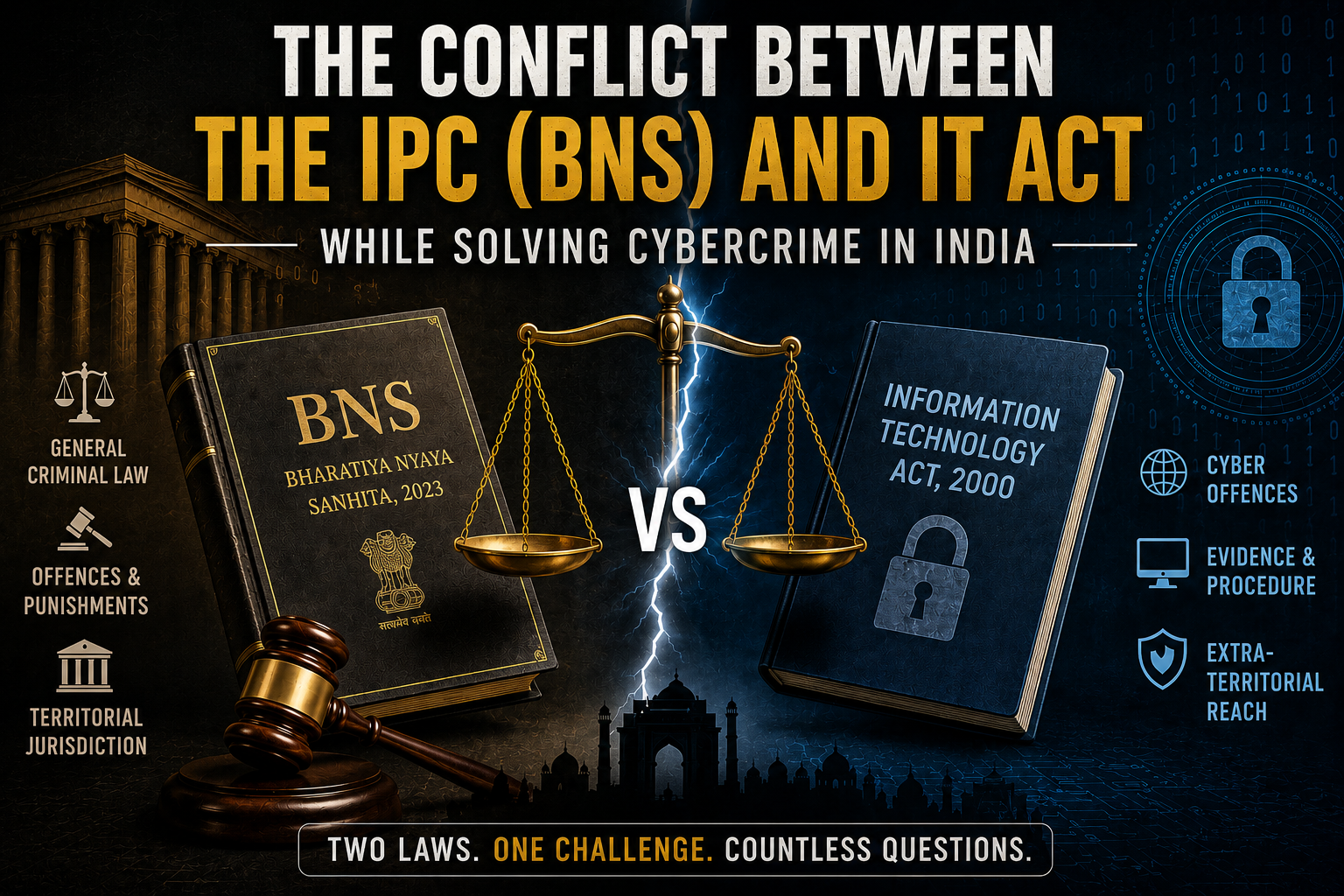
The Conflict between the IPC (BNS) and IT Act while solving cybercrime in India
Inderpreet Kaur, Advocate
Associate Member, JTS Lex
(Author’s perspective)
Introduction
The legal landscape of cybercrime in India is currently a digital "frontier," where the old codes of the physical world meet the specialized logic of the binary. With the replacement of the IPC by the Bharatiya Nyaya Sanhita (BNS) on July 1, 2024, the tension between General Criminal law and the Information Technology (IT) Act, 2000 has entered a sophisticated new chapter.
The "Master of the Key" Conflict:
In the novel Digital Fortress by Dan Brown, a character notes: "The problem with computers is that they don't have a conscience." This lack of "conscience" or physical presence is exactly why the law struggles. Think of the BNS as a seasoned detective who knows every trick in the book but still carries a physical notebook. Meanwhile, the IT Act is the specialized hacker who sees the world in code. When a crime occurs—say, a digital theft—the detective wants to charge them with "Theft" (BNS), but the hacker insists it’s "Unauthorized Access" (IT Act).
As Sherlock Holmes famously said: "When you have eliminated the impossible, whatever remains, however improbable, must be the truth." In Indian jurisprudence, the "truth" has often been that the specialized law must prevail over the general.
⚖️ Key Legal Overlaps: BNS vs. IT Act:
| Offence Category | IT Act, 2000 Provision | BNS, 2023 Provision | The Conflict Point |
|---|---|---|---|
| Identity Theft | Section 66C | Section 318 (Cheating) / 336 (Forgery) | Whether to prosecute under the "Special Law" (IT Act) or "General Law" (BNS). |
| Obscenity | Section 67 | Section 294 (Obscene Acts) | The IT Act has a higher threshold for "publishing" vs. "selling." |
| Data Theft | Section 43/66 | Section 303 (Theft) | Physical "removal" vs. digital "copying." |
| Organized Crime | - | Section 111 | BNS now explicitly includes "cyber-crimes" under organized crime, a power the IT Act lacks. |
1. Sharat Babu Digumarti v. Govt. of NCT of Delhi (2017)
The Fact: This involved the famous Bazee.com case where an obscene clip was listed for sale.
The Interpretation: The Supreme Court held the principle of Generalia Specialibus Non Derogant (special law overrides general law). The Court ruled that if an offence involves an electronic record and falls under the IT Act, the IPC (now BNS) charges cannot be sustained.
Impact: This created a "safe harbor" for intermediaries, suggesting that if the IT Act covers the act, the police cannot simply "add" BNS sections to make the charges more severe.
2. Gagan Harsh Sharma v. State of Maharashtra (2019)
The Fact: Accused were charged under both the IT Act (Sections 43, 66) and IPC (Sections 408, 420) for theft of data/source code.
The Interpretation: The Bombay High Court reiterated that since the IT Act is a special and subsequent law, it would prevail. It noted that the IT Act provides a complete mechanism for "computer-related offences.
🤖 The Animated Perspective:
Consider Megamind; he’s a genius who uses technology to commit "villainy." If he steals a bank's funds via a physical drill, it’s a clear BNS case. But if he uses a "De-Gun" to digitize the money and transfer it? The law enters a grey zone.
The BNS (2023) attempts to bridge this by being "Technology Neutral." Unlike the old IPC, the BNS has updated definitions of "Document" and "Evidence" to include digital records, effectively trying to absorb the IT Act's specialized territory.
"The digital ghost cannot be caged by iron bars alone." The overlap between the BNS and the IT Act not as a conflict, but as a necessary redundancy. While the Sharat Babu precedent suggests the IT Act should prevail, the introduction of Section 111 of the BNS (Organized Crime) changes the game. It allows law enforcement to bypass the often-bailable limitations of the IT Act when cybercrime is committed by syndicates.
The stance is that the IT Act remains the procedural heart (for forensics and electronic signatures), but the BNS is becoming the punitive muscle. For a robust defence or prosecution, one cannot rely on a single statute. The future of Indian cyber-litigation lies in the "Harmonious Construction" of both—treating the IT Act as the lex specialis for the medium, and the BNS as the lex generalis for the intent.