The Diagnostic Detective: Unmasking Pathology Liability in the Era of Modern Medical Law
Inderpreet Kaur, Advocate
Associate Partner, JTS Lex
(Author’s perspective)
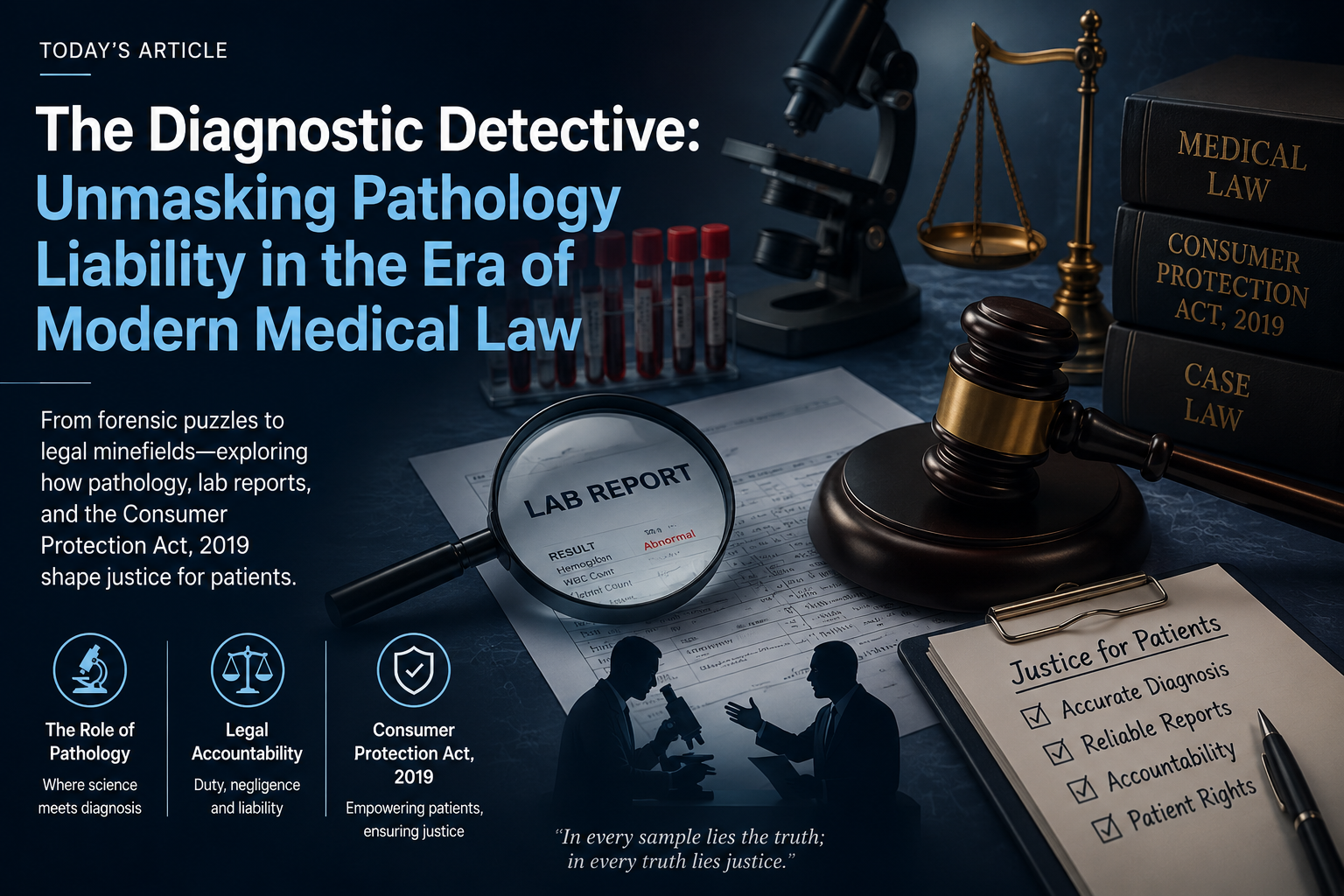
In the binge-worthy world of medical dramas like House M.D. or the forensic puzzles of C.I.D., the lab report is often the "smoking gun" that solves the mystery. But in the real world, a misread slide or a swapped vial isn’t just a plot twist—it’s a legal minefield. For the team at JTS Lex, navigating the intersection of pathology and the Consumer Protection Act (CPA), 2019 is about ensuring that the "science of samples" serves justice as much as it serves health.
1. The Patient as 'Protagonist': The Legal Standing
The shift from "patient" to "consumer" wasn't accidental. The landmark case in 1995, where the Hon’ble Supreme Court’s ruling in Indian Medical Association v. V.P. Shantha brought medical services under the umbrella of consumer law. Under the CPA 2019, any "deficiency in service"—be it an error, omission, or failure to meet the "duty of care"—allows patients to seek redressal through a simplified, three-tier system:
- District Commissions: Claims up to ₹1 crore.
- State Commissions: Claims between ₹1 crore and ₹10 crore.
- National Commission (NCDRC): Claims exceeding ₹10 crore.
2. Pathologies of Negligence: From Screen to Reality
In shows like Grey’s Anatomy, we see doctors making split-second decisions based on lab results. In reality, the legal pitfalls for diagnostic centres often mirror these high-stakes scripts:
• The "False Positive" Nightmare: Imagine a scenario where a patient is wrongly diagnosed with a terminal illness (a classic trope in drama). Legally, this triggers immense psychological trauma and unnecessary, toxic treatments.
• The Mislabelled Mystery: The Delhi State Consumer Disputes Redressal Commission (DSCDRC) proceedings, which often address high-profile medical negligence cases resembling “suspense thrillers” and “Talk shows.” In a notable recent ruling, the Commission held Dr. Lal Pathlabs liable for issuing a "grossly erroneous" medical report that triggered emergency hospitalisation and profound panic. The lab reported a patient's urea levels at more than ten times the normal range, leading doctors to mistakenly suspect life-threatening kidney failure. The Commission observed that such clerical or technical blunders constitute a failure to perform basic testing accurately, causing severe psychological trauma and physical suffering. A similar "identity swap" scenario occurred in a case where a lab issued a wrong pathology report suggesting breast cancer, leading to the unnecessary surgical removal of a patient's breast.
• Shows like, Savdhaan India, in one specific episode, "A Doctor’s Negligence" (Season 45, Episode 50), depicts the consequences of medical errors and the subsequent fight for justice in consumer courts. An international series, Malpractice (2023–2025), a high-stakes medical thriller that begins with a shift from hell and spirals into a conspiracy-filled investigation into a patient's death. It focuses heavily on the accountability of medical professionals and the investigation into their protocols.
• The Physical Toll: Negligence isn't just in the data. Under Section 2(11) of the CPA, even a poorly performed blood draw resulting in nerve damage or hematoma constitutes a "deficiency."
3. Recent Judicial Paradigms: The Hon’ble Supreme Court SpeaksThe Hon’ble Supreme Court of India has recently added layers to the shield of medical law, ensuring that accountability doesn't evaporate:
• Liability Beyond the Grave (2024-2025): In a groundbreaking shift, the Court held that medical negligence claims do not automatically end with the death of a doctor. Legal heirs can now be impleaded, and compensation can be recovered from the deceased doctor’s estate.
• Service vs. Negligence: In Kousik Pal vs. B.M. Birla Heart Research Centre & Ors. (2025 INSC1487),the Hon’ble Supreme Court clarified that a "deficiency in service" (like delayed reports or poor facilities) is distinct from clinical negligence, making it easier for consumers to seek compensation for administrative failures.
• The Burden of Proof: To prevent a "witch hunt" against doctors, the Hon’ble Supreme Court in M.A. Biviji vs Sunita (2024) reiterated that a doctor isn't liable just because a treatment failed. The complainant must provide expert evidence to prove the pathologist’s conduct fell below the "Bolam Test" (the standard of a reasonably competent professional).
4. The Multilateral Shield: Crimes, Privacy, and Vicarious Liability
-
Beyond consumer forums, the legal framework provides a 360-degree protection:
• Vicarious Liability: Labs are responsible for their technicians. However, the law is strict: only a registered medical practitioner with a PG in Pathology can legally sign a report. • Criminal Threshold: Under Section 106 of the Bharatiya Nyaya Sanhita (formerly IPC 304A), "causing death by negligence" leading to death can result in criminal prosecution.
-
• The Digital Vault: Much like the high-tech breaches in Black Mirror, leaking sensitive health data (like HIV or genetic status) is now a severe offense under the Digital Personal Data Protection (DPDP) Act.
-
Conclusion
Whether it is a wrong indicator in a routine CBC or a life-altering error in a histopathology report, the law ensures that patients are never just "another file." At JTS Lex, we bridge the gap between complex medical science and the pursuit of legal redressal, ensuring that every diagnostic mystery has a fair trial.